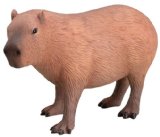
What capybara?
- Posted by: Capybarajp
- I the first to leave a comment

Video commentary Capybara (Special Thanks Izu cactus Park)
♪ enchanted capybara hot springs, hot water in citron
And capybara it? (Wikipedia Japanese | English )
(: Capybara, Spanish: Capibara, Portuguese: English Capivara) The capybara, capybara species of genus only. Scientific name: Hydrochoerus hydrochaeris. Largest species in the rodent extant. With a focus on South America eastern Amazon basin, inhabit the warm water. To form a Caviidae capybara subfamily or Hydrochoeridae in conjunction with fossil species some Kerodon closely related and (Kerodon).
Feature
Capybara is grown 105 ~ 135cm length, up to 35 ~ 65kg body weight. Personality is very calm. And is covered in coarse body hair, such as a scrubbing brush which is also more than 5cm. Swimming is good at, webbed nest-like spider is attached to the forefoot hind leg. It is possible to dive for more than five minutes in the water to swim in crowds, to hide from predators. Sometimes you sleep out on the water only the tip of the nose.
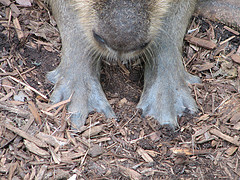
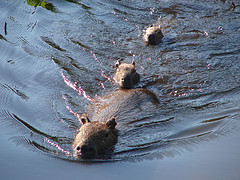
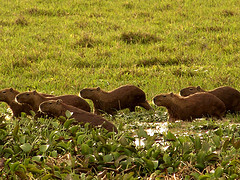
There secretion glands (Morijo) on the nose, when it comes to mating season, males rub leaves surrounding it in order to attract a female. In 150 days, it is not made a nest exceptionally in rodents, produce 1-7 draw a direct offspring of the grass waterside gestation period. You live in a herd of about 10 head consisting of the offspring of the female multiple male and one head, to carry out child-rearing in a group. As the dry season, sometimes performed exodus seeking water park to form a herd of 100 head or consequently. Life 5 to 10 years. In herbivorous, I am active in the morning and evening, to spend to eat grass and leaves etc. in the water in the river.
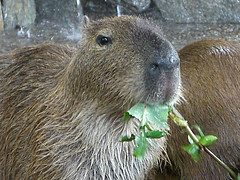
Where it has been bred in Japan
It is bred in zoos all over Japan, but there is also a zoo vulnerable to cold, not on display in the winter (eg Asahiyama Zoo, Ishikawa Zoo). Zoo often population most in Nagasaki Bio Park, vary depending on the year, about 30 individuals or more in captivity. Bio Park has become a free-range state substantially, it is possible to direct contact with capybara. Introduced a method that can be touched directly in the country of Ichihara Elephant.
Where it has changed, in capybara being kept in Izu cactus Park, winter can observe the appearance entering the spa. There is also water is allowed hit not only springs bio-park. In addition, Prince Akishino statement Hitoshi is raised along with the alligator snapping turtle, such as Mara and at home. In addition, Cuddly Dominion in Aso in Kumamoto: may even (formerly known as Aso Bear Park), we have been bred, it'll be in a normal cage, but good weather is free-range in the garden, that direct contact There are times when you can. It can also be seen in the Osaka Aquarium in Osaka.
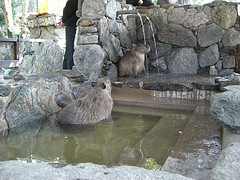
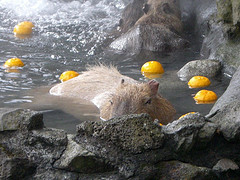
Capybara as meat
In the Parana river basin region of southern Brazil origin, northern Argentina, Uruguay, be captured in order to food and livestock were many. Country to ban the hunting became more at present, but the meat of the capybara is taste like pork when you, it has been developed to meat in Venezuela, it is food preferred by Easter in particular. There was a company that imported meat as a sample to a Japanese trading company, have tried to develop the market, but the story flesh apparently was Kataka~tsu, that it has started importing in earnest not heard. It is classified as a fish in the Vatican for the edible.
Nickname Capybara
Japanese name demon guinea pig (demon Tenjikunezumi).
The Chinami of Guarani language "Kapiyva" (the main grassland), the capybara, came to be called "capibara" it is corruption in Spanish. How to call there is a lot of countries.
* Karupincho
* Kapincho
* Capybara (or more, Argentina, Bolivia, Uruguay, Paraguay, Mexico)
* Pueruko de Agua
* Pueruko de Rio
* Serudo de Rio
* Kapiba
* Martha mop
* Nakupiaga
* Jeratai
* Amor
* Nachiguese
* Warikeraito
* Mikiro (or more, Argentina)
* Capybara (Northwest Argentina, Bolivia, Brazil)
* Pirro - Pirro
* Chiguire (or more, Argentina, Venezuela)
* Horde (Bolivia)
* Chiguire
* Chiguiro (or more, Colombia)
* Ronsoko (Peru)
* Poncho (Panama)
And.